Lattice-Based Signatures: Hash-and-Sign, Fiat-Shamir
Trapdoors for hard lattices and new cryptographic constructions
First showed how to solve DGS in polynomial time for large parameters.
The sampling algorithm itself is actually a simple randomized variant of Babai’s nearest-plane algorithm [Bab86], which was originally proposed by Klein [Kle00] in another context.
The early GGH signature proposal of Goldreich, Goldwasser, and Halevi [GGH97] was directly related to a certain lattice problem, but it lacked a security proof, and recently, Nguyen and Regev [NR06] showed how to recover the entire secret key (or its equivalent) from a transcript of signatures.
So the paper proposes a Hash-and-Sign / Identity-Based Encryption based on Preimage Sampleable Functions (PSF).
Below is the signature scheme based on lattice trapdoors. Here TrapGen generates a trapdoor function and its trapdoor \((f_a,t)\); SampleDom outputs \(x\) randomly such that \(f_a(x)\) is uniform; SamplePre receives \(y\) and outputs \(x\) according to the conditional distribution \(x\leftarrow \mathrm{SampleDom}()\mid f_a(x)=y\).
The PSF is realized by \((f_A,T)\) be the function-trapdoor pair, with \(f_A(x)=Ax\bmod q\) and \(T\) be a good basis. The inverse \(\mathrm{SampleISIS}(A,T,s,u)\) first computes \(At=u\bmod q\) by linear algebra methods; then sample \(v\sim D_{\Lambda^\bot(A),s,-t}\) using Gaussian sampler w.r.t basis \(T\).
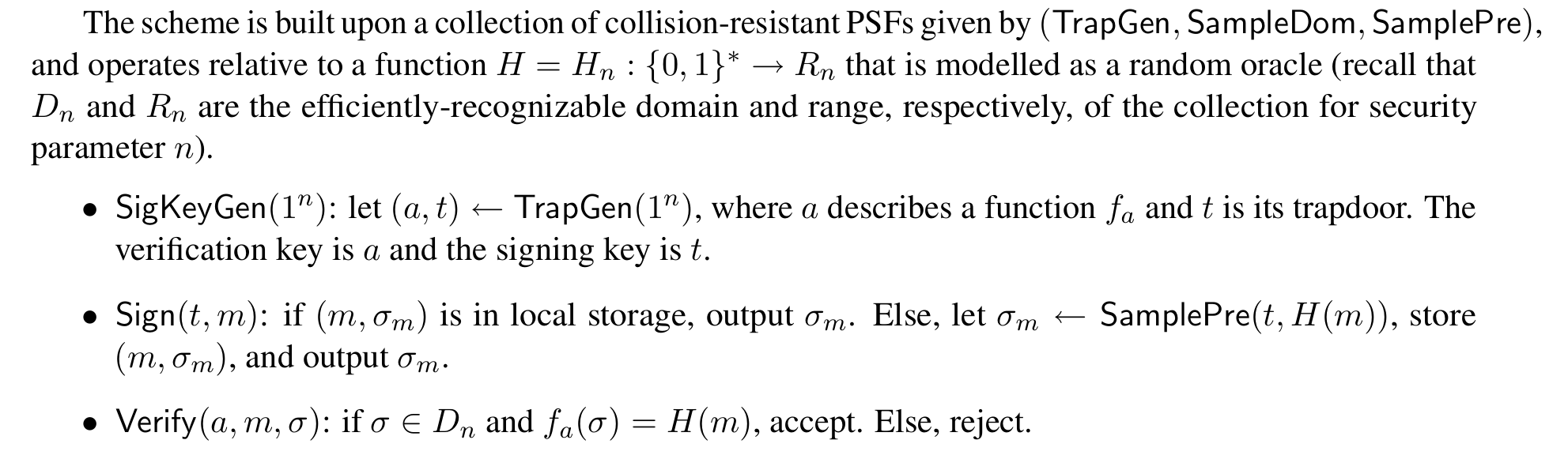
This is the Hash-and-Sign regime, where we first hash the message, then use the trapdoor to sample a preimage as the signature. The verification only computes the trapdoor function.
GGH signature: pk=basis \(B\), sk=a good basis \(T\); signature= \(v\) the closest vector of \(H(m)\)
So by signing a large amount of messages, the attacker can see the parallelpipe by collecting \(H(m)-v\). [GPV08] avoids the weakness of GGH to generate within a range of close vectors of \(H(m)\).
Additionally, GPV08 provides a sampling algorithm as follows:
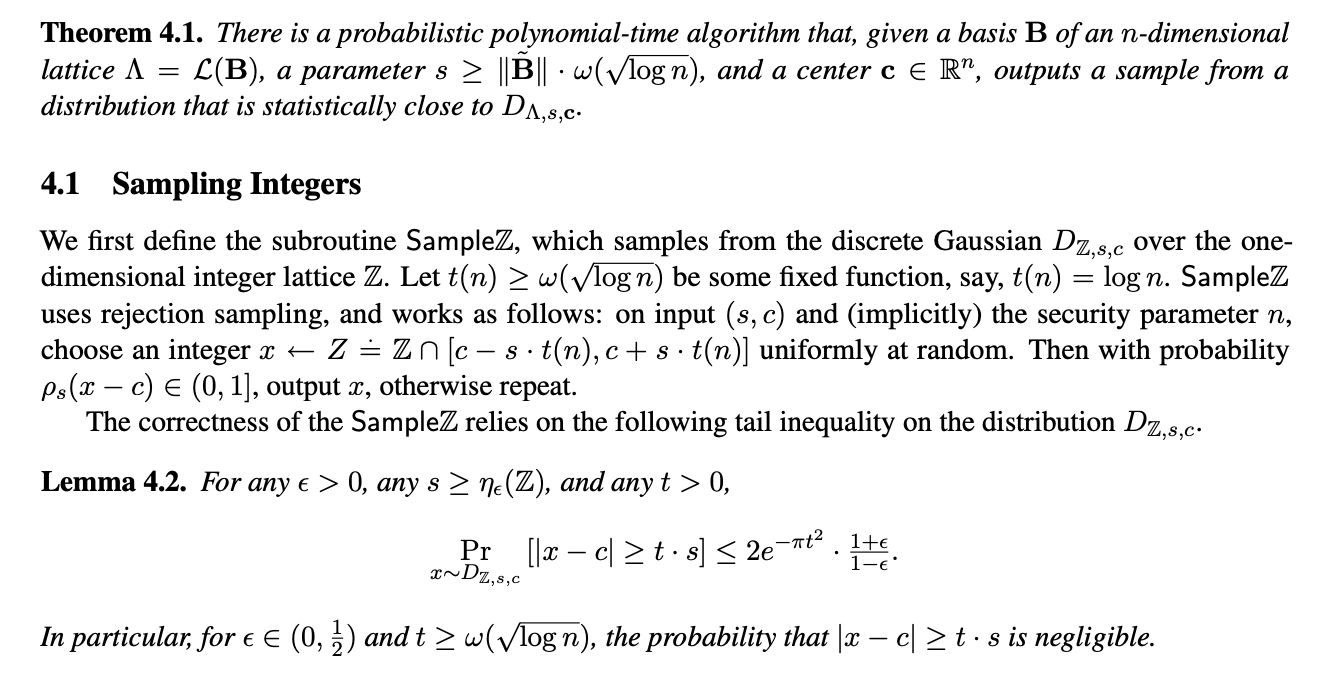
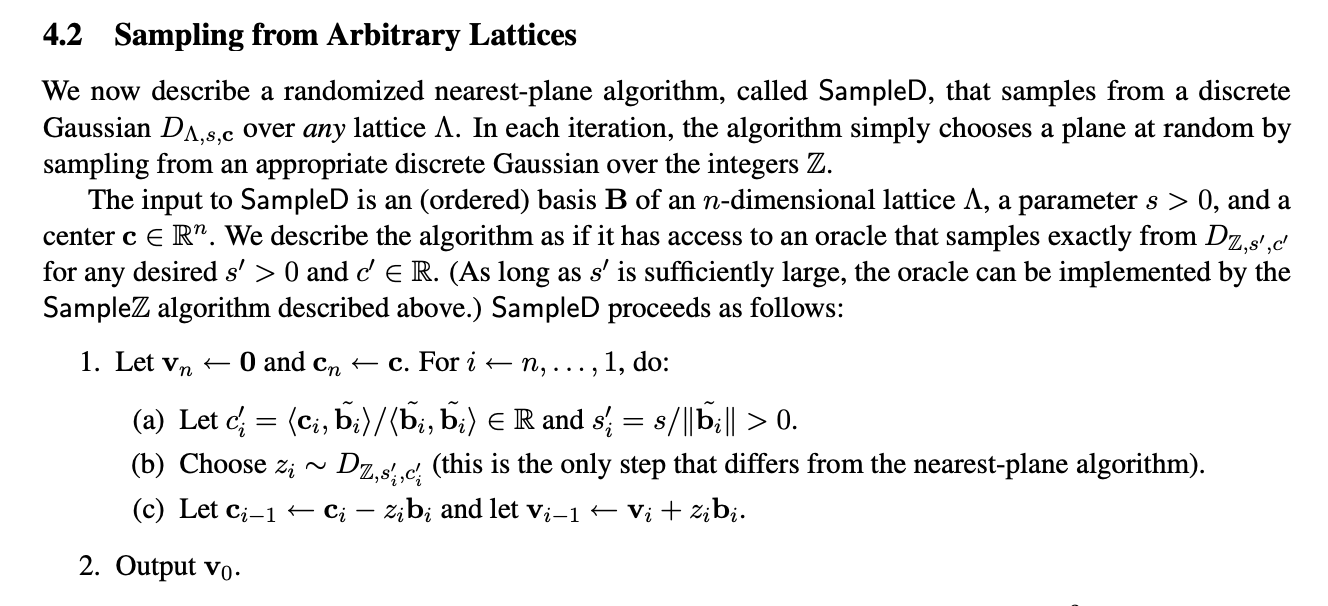
This algorithm only adjusts a little from Babai’s nearest-plane algorithm.
A following work [PT26] extends this construction without Gaussian sampling.
Lattice Signatures Without Trapdoors
Fiat-Shamir with abort, which is a new method other then [GPV08]’s Hash-and-Sign.
In Quorus: Essentially all prior works on lattice-based threshold signatures based on the Fiat-Shamir transform either rely on threshold homomorphic encryption or attempted to leverage the similarities between Lyubashevsky-like signatures [Lyu12] and Schnorr.
Solving the Shortest Vector Problem in \(2^n\) Time via Discrete Gaussian Sampling
Solve SVP through SIS and reduce variance during each sampling/sieving
Classical Hardness of Learning with Errors
A concrete Gaussian sampler with relatively large variance
Lattice-Based Identification Schemes Secure Under Active Attacks
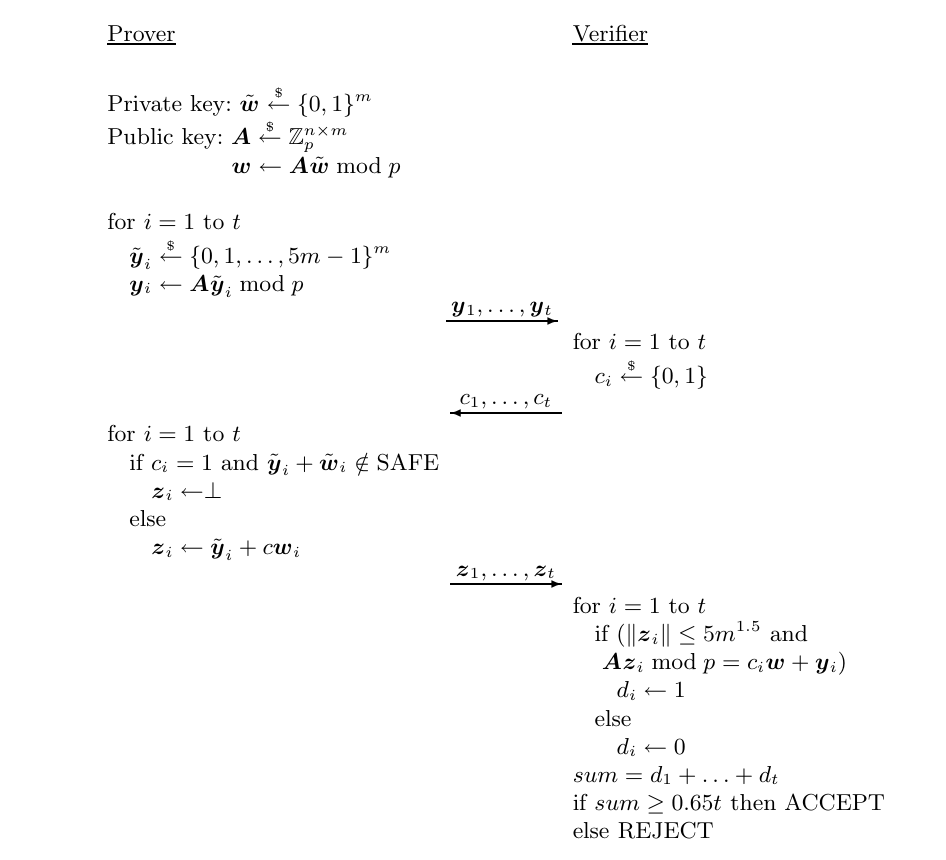
The first signature with rejection sampling for ID scheme
The paper also includes lemmas from [Reg05]:
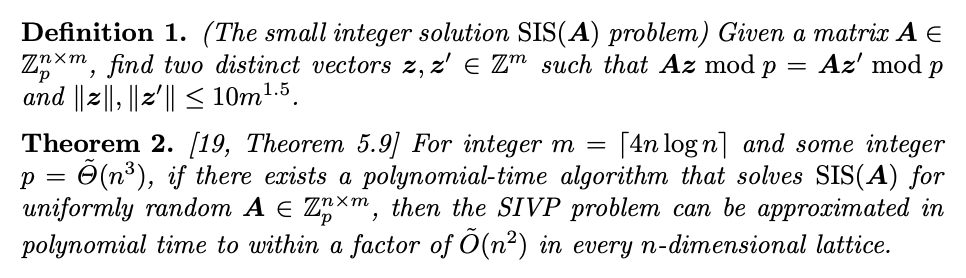
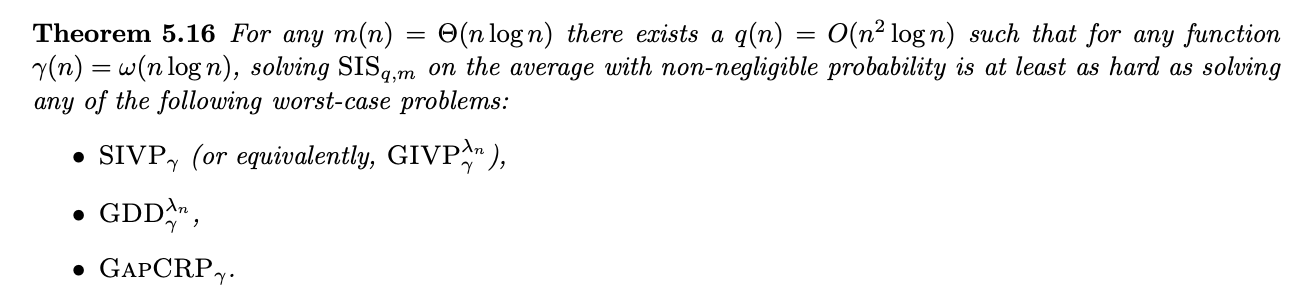
and from [LM06]:

Ideal Lattices
Generalized compact knapsacks, cyclic lattices, and efficient one-way functions
[Micciancio02] OWF using cyclic lattices (ideal lattices are extension of them)
Generalized Compact Knapsacks Are Collision Resistant
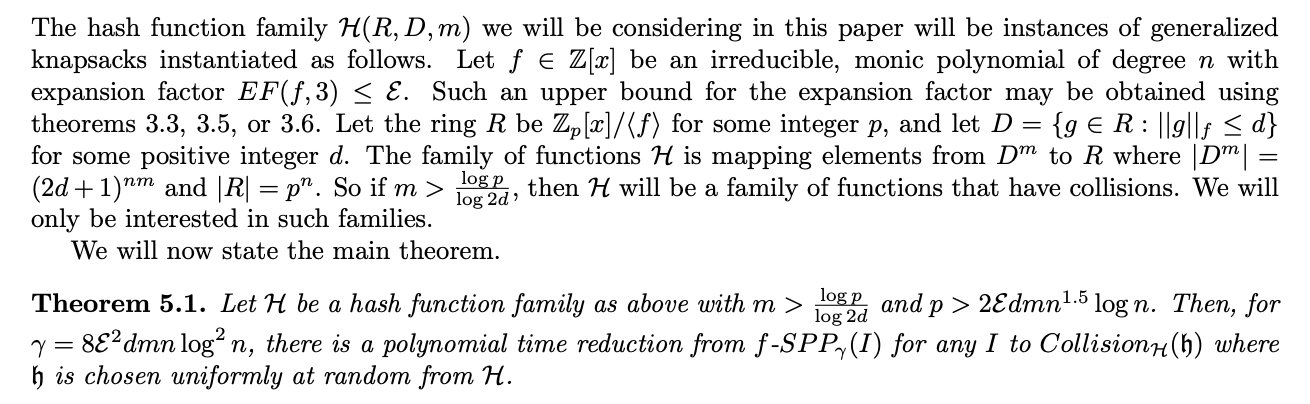
[LM06] Lyubashevsky & Micciancio
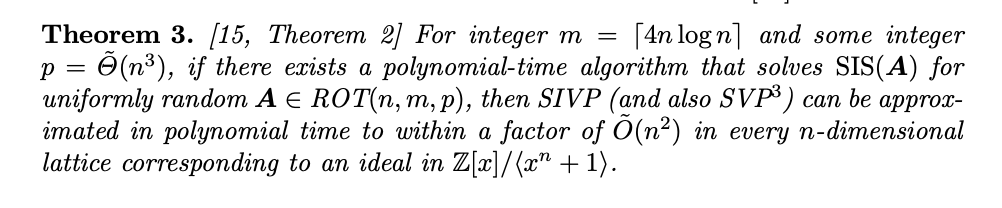
Ideal lattices were first studied in the context of cryptography in it, concerning worst-case to average-case reduction. Here is the main theorem, formulated in [Lyu08]:
Theorem 2. For integer \(m = \lceil 4n \log n \rceil\) and some integer \(p = \tilde{O}(n^3)\), if there exists a polynomial-time algorithm that solves \(\mathrm{SIS}(A)\) for uniformly random \(A \in \operatorname{ROT}(n, m, p)\), then SIVP (and also SVP) can be approximated in polynomial time to within a factor of \(\tilde{O}(n^2)\) in every \(n\) -dimensional lattice corresponding to an ideal in \(\mathbb{Z}[x] / \langle x^n + 1 \rangle\).
On Ideal Lattices and Learning with Errors Over Rings
[LPR12] Lyubashevsky, Peikert, Regev